
Agencies face a growing challenge in 2026: clients demand specialized local SEO expertise, but building an in-house team is expensive and time-consuming. White label local SEO services solve this problem by letting agencies offer professional local search optimization under their own brand without hiring full-time specialists. This partnership model helps agencies scale faster, serve more clients, and compete with larger firms while maintaining complete control over client relationships and pricing.
What Are White Label Local SEO Services
White label local SEO services are specialized search optimization solutions provided by an external team that agencies can rebrand and resell as their own. The provider handles all technical work, research, optimization, and reporting while your agency maintains the client relationship and presents the results under your brand name.
This arrangement works differently than traditional outsourcing. You’re not just hiring contractors. You’re partnering with specialists who understand they need to stay invisible to your clients.
The core components typically include:
- Google Business Profile optimization and management
- Local citation building and NAP consistency
- Location-specific keyword research and targeting
- On-page optimization for local search intent
- Review generation and reputation management
- Local link building campaigns
- Monthly performance reports branded with your logo
The provider becomes an extension of your team. They follow your processes, match your communication style, and adapt to your client’s specific needs.

How the Partnership Model Works
You maintain the client relationship while the white label provider delivers the actual SEO work. Most arrangements follow a simple process: you onboard the client, gather their business information and goals, then pass those details to your provider. They create a customized strategy, execute the work, and send you branded reports that you deliver to your client.
Payment structures vary but commonly include:
| Model | How It Works | Best For |
|---|---|---|
| Per-project | Fixed fee for specific deliverables | One-time optimization projects |
| Monthly retainer | Recurring fee for ongoing services | Long-term client relationships |
| Revenue share | Percentage of what you charge clients | Agencies testing the model |
| Hybrid | Combination of setup fee plus monthly | Balanced risk and commitment |
Most agencies mark up the provider’s cost by 30-50% to maintain healthy margins while staying competitive.
Why Agencies Choose White Label Local SEO Services
Agencies choose white label local SEO services because they can immediately offer specialized expertise without the overhead of hiring, training, and managing in-house staff. This decision typically comes from recognizing that local SEO requires specific knowledge that takes years to develop.
Building an internal local SEO team means recruiting specialists, investing in tools and training, managing workflows, and accepting the risk that employee turnover could devastate your service delivery. A single experienced local SEO specialist in the United States costs $60,000-$90,000 annually before benefits and tools.
White label partnerships eliminate these barriers. You pay only for the work delivered, scale up or down based on client demand, and tap into teams that already have proven processes and tools.
Immediate Access to Specialized Skills
Local SEO differs significantly from general search optimization. It requires understanding Google Business Profile algorithms, local pack rankings, citation ecosystems, and location-based intent signals. White label SEO providers specialize in these areas because they focus exclusively on this work.
The learning curve for local SEO is steep. Google’s local algorithm includes factors like proximity, relevance, and prominence that interact in complex ways. Review signals, citation consistency, and local link quality all impact rankings differently than in traditional SEO.
Your white label partner brings this expertise immediately, along with:
- Established relationships with citation sources
- Proprietary tools for local rank tracking
- Templates for optimizing Google Business Profiles
- Proven strategies for different business categories
- Experience managing thousands of local campaigns
Key Services Included in White Label Local SEO
White label local SEO services encompass everything needed to improve a business’s visibility in location-based searches. The scope goes far beyond basic optimization to include ongoing management, monitoring, and strategic adjustments.
Google Business Profile Management
Every local SEO campaign centers on the Google Business Profile (formerly Google My Business). Your white label provider optimizes every element: business categories, service areas, hours, descriptions, attributes, photos, and posts.
They also handle:
- Weekly posts with local keywords and calls-to-action
- Photo uploads showcasing products, services, and location
- Q&A monitoring and responses
- Review response management
- Insight tracking and reporting
- Google Business Profile updates based on algorithm changes
This ongoing management keeps profiles active and signals to Google that the business is legitimate and engaged with customers.
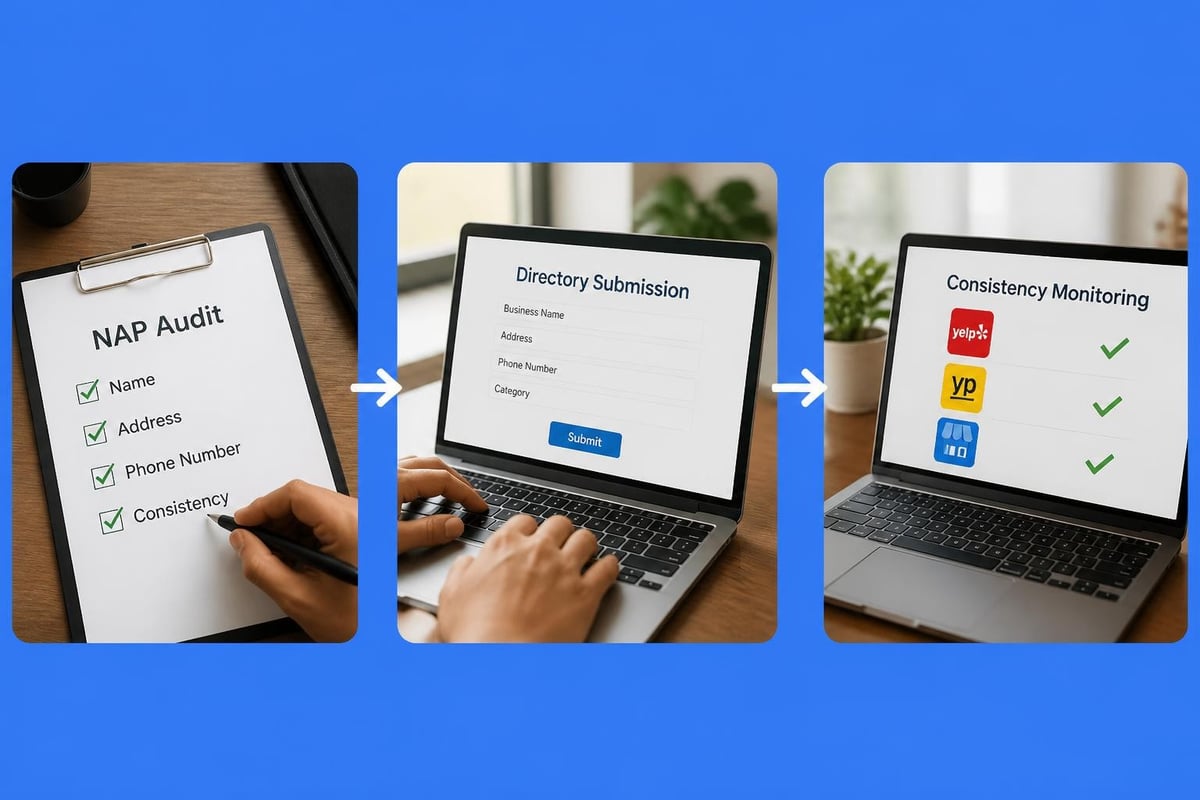
Citation Building and Management
Citations are online mentions of a business’s name, address, and phone number (NAP). Consistency across hundreds of directories, review sites, and platforms directly impacts local rankings.
White label providers audit existing citations, correct inconsistencies, and build new citations on relevant platforms. They prioritize directories based on industry relevance and domain authority.
A comprehensive citation campaign includes:
- Audit of existing citations across 50-100+ platforms
- Correction of NAP inconsistencies
- Submission to core directories (Google, Bing, Apple Maps, Yelp)
- Industry-specific directory listings
- Local business association listings
- Ongoing monitoring for new duplicate listings
Location-Specific Content and Optimization
Local SEO requires content that targets location-based search intent. Your provider researches keywords that combine services with geographic modifiers, then creates optimized content around these terms.
This includes:
- Location pages targeting each service area
- City-specific blog content
- Service pages with local relevance
- Schema markup for local business information
- Optimized title tags and meta descriptions with location keywords
- Internal linking strategies that strengthen local relevance
The content balances search optimization with genuine value for local customers. It answers questions about service areas, local expertise, and community involvement.
Choosing the Right White Label Local SEO Provider
Choosing the right white label local SEO provider requires evaluating their technical capabilities, communication systems, and understanding of your agency’s specific needs. Not all providers offer the same quality or service level.
Start by assessing their track record. Ask for case studies showing measurable local ranking improvements. Request client references you can contact directly. Review their own local SEO performance-a provider that can’t rank their own site raises red flags.
Technical Capabilities and Tools
Your provider should use professional-grade tools and maintain access to the platforms that matter most for local SEO. SEMrush’s white label SEO guide emphasizes the importance of tool access and reporting capabilities.
Evaluate their tool stack:
| Tool Category | What to Look For | Why It Matters |
|---|---|---|
| Rank tracking | Local grid tracking across multiple locations | Accurate performance measurement |
| Citation management | Automated submission and monitoring | Efficiency and consistency |
| Review monitoring | Multi-platform tracking and alerts | Timely reputation management |
| Reporting | White label, customizable dashboards | Professional client presentations |
They should also demonstrate familiarity with Google Search Console, Google Analytics, and Google Business Profile Insights for comprehensive performance analysis.
Communication and Reporting Standards
Clear communication determines whether a white label partnership succeeds or creates frustration. Your provider must respond quickly to questions, provide regular updates, and deliver reports on schedule.
Essential communication elements:
- Dedicated account manager or point of contact
- Response time commitments (ideally within 24 hours)
- Regular status updates on campaign progress
- Transparent reporting showing work completed and results achieved
- Crisis management protocols for urgent issues
Reports should be fully white-labeled with your agency’s branding. They must explain results in language your clients understand, not just industry jargon.
Pricing Models for White Label Local SEO Services
Pricing models for white label local SEO services vary based on the scope of work, number of locations, competition level, and whether the engagement is project-based or ongoing. Understanding these structures helps you price your own services competitively while maintaining healthy margins.
Most providers offer tiered packages that scale with client needs. A single-location local business requires different resources than a multi-location franchise.
Common pricing tiers:
- Basic local package: $300-$600/month per location (GBP optimization, basic citations, review monitoring)
- Standard local package: $600-$1,200/month per location (adds content creation, link building, ongoing optimization)
- Advanced local package: $1,200-$2,500/month per location (comprehensive strategy, competitive markets, multiple locations)
Setup fees often apply for new clients, ranging from $500-$2,000 depending on the initial audit, citation cleanup, and optimization required.
Calculating Your Agency Markup
Your markup should cover your overhead, account management time, and desired profit margin while remaining competitive in your market. Most agencies apply a 40-60% markup on white label services.
Example pricing calculation:
If your provider charges $800/month for a standard package:
- Your cost: $800
- Your account management time: $200 (estimated value)
- Total cost: $1,000
- 50% markup: $500
- Client price: $1,500/month
This structure gives you healthy margins while delivering value. You’re not just reselling-you’re providing strategy, communication, and results interpretation that clients need.
Scaling Your Agency with White Label Local SEO
Scaling your agency with white label local SEO services means systematically adding clients without proportionally increasing your overhead or staffing needs. This growth strategy works because the provider handles fulfillment while you focus on sales, strategy, and client relationships.
Local SEO statistics show that 46% of all Google searches have local intent, creating enormous demand that agencies can capture. The key is building repeatable systems for onboarding, communication, and reporting.
Agency scaling model comparing traditional in-house growth versus white label partnerships, showing how revenue per employee increases and overhead stays controlled with the white label approach
Building Repeatable Systems
Create standardized processes for every client interaction. Document your onboarding questions, information gathering forms, and expectation-setting conversations. This consistency lets you handle more clients without chaos.
Your systems should cover:
- Initial client consultation and needs assessment
- Information gathering (business details, competitors, goals)
- Proposal creation and pricing presentation
- Contract signing and payment setup
- Client information handoff to white label provider
- Regular check-ins and report delivery
- Renewal conversations and upselling opportunities
Most successful agencies use project management tools to track where each client stands in this workflow. This visibility prevents dropped balls as you scale.
Managing Client Expectations
White label relationships succeed when clients receive consistent value and clear communication about what to expect. Set realistic timelines for results-local SEO typically shows meaningful improvement within 3-6 months.
Educate clients about the process: Explain that local SEO involves optimizing their online presence across dozens of platforms, not just their website. Share the work being done through monthly reports that show specific actions taken and early indicators of progress.
If you’re partnering with a white label SEO provider who understands local markets, they’ll provide detailed reports showing citation builds, ranking improvements, and traffic growth that you can present with confidence.
Common Challenges and How to Solve Them
White label local SEO services present specific challenges that agencies must anticipate and address proactively. The most common issues revolve around quality control, communication gaps, and client retention during the waiting period before results appear.
Quality Control and Consistency
You can’t directly supervise work done by your white label provider, so you need verification systems. Request access to their project management tools or regular work samples before deliverables go to clients.
Implement these quality checks:
- Review monthly reports before sending to clients
- Spot-check citation submissions using tools like Moz Local or BrightLocal
- Monitor Google Business Profile changes weekly
- Track ranking changes independently using your own tools
- Request explanations for any unexpected results or missed deadlines
Schedule quarterly reviews with your provider to discuss performance across all clients, identify improvement opportunities, and address any recurring issues.
Maintaining Client Relationships
Some agencies worry that white label providers might bypass them and contact clients directly. Strong contracts prevent this, but selecting a provider with integrity matters more than legal documents.
Protect your client relationships by:
- Choosing providers with proven track records and references
- Including non-compete and non-solicitation clauses in agreements
- Maintaining regular communication with clients yourself
- Being the primary point of contact for all questions
- Adding strategic value beyond just delivering reports
Your role goes beyond project management. Offer business insights, marketing strategy, and consultation that positions you as an essential partner.
Measuring Success in Local SEO Campaigns
Measuring success in local SEO campaigns requires tracking multiple metrics that collectively show improved visibility, engagement, and business results for your clients. Rankings alone don’t tell the complete story.
Primary metrics to track:
| Metric | What It Measures | Target Trend |
|---|---|---|
| Local pack rankings | Position in map results for key terms | Upward movement |
| Organic local rankings | Position in regular search results with location intent | First page placement |
| Google Business Profile views | How often the profile appears in search and maps | 20-30% monthly increase |
| Website clicks from GBP | Traffic driven from the business profile | Steady growth |
| Direction requests | Users asking for directions to location | Correlates with foot traffic |
| Phone calls | Calls made directly from search results | High-intent conversions |
| Review quantity and rating | Total reviews and average star rating | Growing quantity, maintaining 4.0+ rating |
Your white label provider should track and report on all these metrics monthly, showing progress over time and comparing performance to initial benchmarks.
Connecting SEO to Business Outcomes
Clients ultimately care about revenue, not rankings. Help them connect SEO improvements to business results by tracking conversion data alongside visibility metrics.
When website traffic from local search increases by 50% and phone calls double, that’s a story that justifies continued investment. Local SEO strategies that drive measurable business impact create client loyalty and reduce churn.
Work with clients to establish goal values for different conversion types. If the average phone call generates $500 in revenue and SEO drives 20 additional calls per month, that’s $10,000 in attributable value-easy to justify against a $1,500 monthly investment.
Integrating White Label Services Into Your Agency
Integrating white label services into your agency requires positioning them as a natural extension of your existing offerings, not a separate or inferior option. Your team needs to understand the service, believe in its value, and communicate it confidently to prospects and clients.
Start with internal education. Brief your sales and account management teams on what local SEO involves, why it matters for clients, and how your white label partnership delivers results. They should be able to answer basic questions and identify good prospects for local SEO services.
Training Your Team
Your staff doesn’t need to become local SEO experts, but they should understand fundamentals well enough to have intelligent conversations with clients. Create an internal knowledge base covering:
- What local SEO is and which clients need it
- How local search differs from traditional SEO
- The services included in your packages
- Realistic timelines for results
- How to interpret monthly reports
- Common client questions and approved answers
Role-play client conversations so team members practice explaining complex concepts in simple terms. Confidence comes from preparation.
Creating Service Packages
Package your white label local SEO services in tiers that match different client needs and budgets. Most agencies offer three levels: starter, professional, and enterprise.
Each package should clearly define:
- What’s included (specific deliverables)
- What results clients can expect (realistic goals)
- How long the engagement lasts (minimum terms)
- What the client needs to provide (access, information)
- How communication and reporting work (frequency, format)
Price packages based on your market research, competitor analysis, and target profit margins. Don’t compete on price alone-emphasize the value and results your partnership delivers.
Long-Term Partnership Development
Long-term partnerships with white label local SEO providers develop through consistent performance, clear communication, and aligned business goals. The best relationships evolve beyond simple vendor-client transactions into genuine collaborations.
Invest in these relationships by:
- Providing detailed feedback on what works and what needs improvement
- Sharing your business growth plans so providers can scale with you
- Negotiating volume discounts as you bring more clients
- Exploring exclusive arrangements if the partnership proves valuable
- Collaborating on case studies that benefit both businesses
Strong providers value agencies that send quality clients, communicate clearly, and pay promptly. They’re often willing to customize their services, adjust pricing, or provide additional support for agencies they consider long-term partners.
Continuous Improvement and Adaptation
Local SEO changes constantly as Google updates its algorithms and user behavior shifts. Your white label provider should proactively adapt strategies based on industry changes.
Schedule quarterly strategy reviews to discuss:
- Recent algorithm updates and their implications
- Emerging local SEO tactics worth testing
- Performance trends across your client portfolio
- New service offerings or package adjustments
- Industry developments affecting your clients
This ongoing dialogue ensures your local SEO services remain current and competitive throughout 2026 and beyond.
Concolusion
White label local SEO services give agencies the specialized expertise, scalable fulfillment, and professional tools needed to compete in the growing local search market without massive infrastructure investments. By choosing the right partner, implementing strong systems, and focusing on measurable results, your agency can deliver exceptional value while maintaining healthy margins and sustainable growth. If you’re ready to scale your agency with proven local SEO expertise, Cyrel P. Nicolas brings nearly 15 years of experience helping agencies deliver results that strengthen client relationships and build recurring revenue.