The landscape of search engine companies has transformed dramatically over the past two decades, reshaping how billions of people access information online. These companies control the gateways to digital content, determining which websites appear in results and how users interact with information. For businesses and SEO professionals, understanding who runs these platforms and how they operate directly impacts visibility strategies, traffic sources, and ultimately revenue.
What Are Search Engine Companies and Why Do They Matter
Search engine companies are technology firms that develop and maintain platforms allowing users to search for information across the internet. They matter because they control how people discover content, products, and services online, making them critical to digital marketing success.
The Core Business Model Behind Search Engines
Most search engine companies generate revenue through advertising, particularly paid search ads that appear alongside organic results. Google pioneered this model with AdWords (now Google Ads), creating a multi-billion dollar industry. The basic framework includes:
- Indexing billions of web pages through automated crawlers
- Ranking content based on proprietary algorithms
- Displaying relevant results to user queries
- Monetizing through sponsored listings and display ads
Some search engine companies take different approaches. DuckDuckGo, for instance, focuses on privacy and doesn’t track users, while still generating revenue through non-personalized ads and affiliate partnerships.
How Search Engines Impact Business Visibility
The search engine you rank on determines your potential audience reach. Since Google’s search market share recently dipped below 90%, businesses now have more opportunities to diversify their traffic sources. However, Google still dominates, making it the primary focus for most SEO strategies.
Different search engine companies use distinct ranking factors, though core principles like content quality, user experience, and authority remain consistent across platforms.

Major Search Engine Companies Dominating the 2026 Market
The search engine market in 2026 remains concentrated among a handful of powerful players, though competitive dynamics have shifted with AI integration and privacy concerns.
Google and Alphabet: The Undisputed Leader
Google continues to lead global search, though its dominance faces new challenges. Alphabet Inc., Google’s parent company, has evolved beyond search into cloud computing, autonomous vehicles, and healthcare technology. This diversification reflects both the company’s ambitions and recognition that search advertising alone may not sustain long-term growth.
According to comprehensive market share statistics for 2026, Google holds approximately 88% of the global search market, a slight decline from previous years. This shift reflects growing competition from AI-powered alternatives and privacy-focused platforms.
| Search Engine | Market Share 2026 | Primary Differentiator |
|---|---|---|
| 88% | Comprehensive results, AI features | |
| Bing | 6% | Microsoft integration, ChatGPT |
| Yandex | 2% | Russian market dominance |
| DuckDuckGo | 1.5% | Privacy protection |
| Others | 2.5% | Regional or specialized focus |
Microsoft Bing: The Persistent Challenger
Bing has carved out a meaningful position in the search market through integration with Windows, Edge browser, and business tools. The introduction of AI chat features powered by ChatGPT has given Microsoft a competitive edge in conversational search.
For businesses, Bing’s approach without heavy AI interference sometimes delivers cleaner, more traditional results that some users prefer. This creates optimization opportunities for companies targeting specific demographics or enterprise users.
Alternative Search Engines Gaining Traction
Search engine companies beyond Google and Bing serve growing niches:
- DuckDuckGo emphasizes privacy with no user tracking
- Yandex dominates Russian-language searches and Eastern European markets
- Baidu controls China’s search ecosystem
- Ecosia attracts environmentally conscious users by planting trees with ad revenue
These alternatives represent diversification opportunities for international SEO strategies and audiences with specific values or preferences.
The AI Revolution Transforming Search Engine Companies
Artificial intelligence has fundamentally changed how search engine companies operate, from result generation to user interaction patterns.
Google Zero and the Traffic Apocalypse
The concept of Google Zero, where AI provides direct answers on search pages, has created anxiety among publishers and content creators. When users get complete answers without clicking through to websites, organic traffic drops significantly.
This shift impacts how businesses approach content strategy. Instead of simply ranking, companies must now:
- Create content that can’t be summarized in AI snippets
- Build brand authority that drives direct traffic
- Focus on conversion optimization for reduced traffic volumes
- Develop multiple traffic channels beyond organic search

Will AI Make Traditional Search Obsolete
Some industry leaders believe search engine companies face existential threats from AI. The discussion around whether AI will make search redundant highlights fundamental changes in information access.
Rather than replacing search entirely, AI appears to be transforming it into a more conversational, context-aware experience. Search engine companies are integrating AI features while maintaining traditional result formats, creating a hybrid model.
How Search Engines Are Adapting Their Algorithms
Modern search engine companies continuously refine their algorithms to address AI-generated content, user intent, and quality signals. Key adaptations include:
- Content authenticity detection to identify AI-written versus human-created content
- Experience, Expertise, Authoritativeness, and Trustworthiness (E-E-A-T) signals
- User engagement metrics measuring actual satisfaction beyond clicks
- Multi-modal search incorporating images, video, and voice queries
These changes require businesses to focus on genuine expertise and user value rather than gaming algorithmic loopholes. For companies seeking to improve their visibility, working with experienced professionals who understand these evolving requirements becomes essential. Affordable SEO services can help businesses navigate these complex algorithm updates without massive internal resources.
How Different Search Engine Companies Handle Results
The way search engine companies present and prioritize information varies significantly, affecting where businesses should focus optimization efforts.
Understanding Result Diversity Across Platforms
Research comparing source distribution and result overlap among major search engines reveals important differences in how platforms select and display content. Google tends to favor larger, established sites, while Bing sometimes surfaces smaller, niche publishers more prominently.
For SEO strategy, this means:
- Content that ranks well on Google may not perform identically on Bing
- Diversifying across search engines reduces dependency on a single traffic source
- Different platforms may serve different segments of your target audience
- Testing visibility across multiple search engine companies provides competitive insights
The Evolution of Search Result Pages
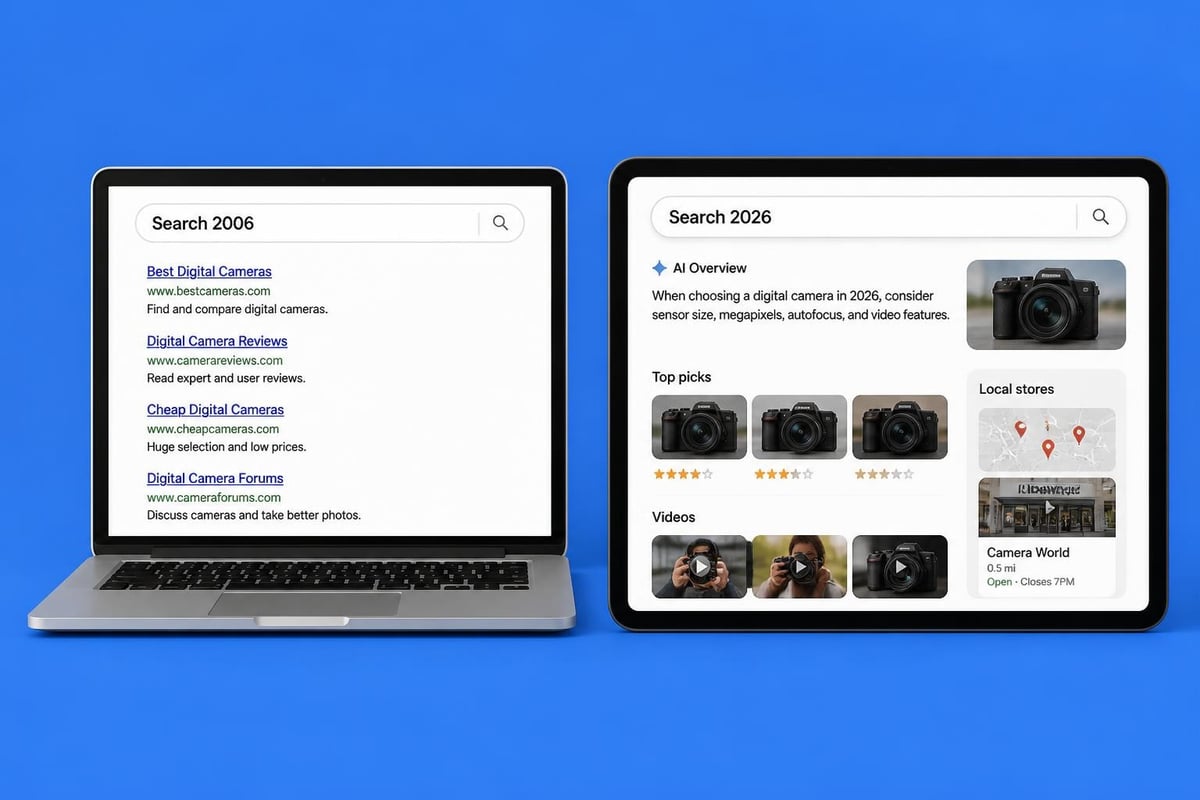
Google Search’s user interface has evolved significantly over two decades, transforming from simple blue links to rich, multimedia experiences with featured snippets, knowledge panels, and video carousels.
Traditional SERP Elements:
- Organic listings
- Paid ads
- Meta descriptions
Modern SERP Features:
- AI overviews
- People Also Ask boxes
- Featured snippets
- Local pack results
- Image and video carousels
- Knowledge graphs
- Shopping results
Optimizing for these diverse formats requires different tactics than traditional SEO. Structured data markup, video content, and location optimization have become as important as keyword targeting.
| SERP Feature | Optimization Tactic | Business Benefit |
|---|---|---|
| Featured Snippets | Clear question-answer format | Position zero visibility |
| Local Pack | Google Business Profile optimization | Geographic visibility |
| People Also Ask | Comprehensive FAQ content | Multiple result positions |
| Video Carousel | YouTube optimization | Multimedia exposure |
| Knowledge Panel | Brand entity building | Authority signals |
Market Share Analysis and Competitive Dynamics
Understanding how search engine companies compete and maintain market position helps businesses make informed SEO investment decisions.
Google’s Declining but Still Dominant Position
While Google’s market share remains overwhelming, the decline below 90% for the first time in years signals meaningful shifts. Academic analysis of Google’s market share under horizontal and vertical segmentation reveals nuanced patterns in specific search categories and demographics.
Younger users increasingly turn to TikTok, Instagram, and other social platforms for certain types of searches, particularly product discovery and local recommendations. This fragments the search landscape beyond traditional search engine companies.
Regional Variations in Search Engine Preference
Search engine dominance varies dramatically by geography:
- Russia: Yandex commands significant market share
- China: Baidu dominates with Google blocked
- South Korea: Naver leads local search
- Czech Republic: Seznam remains competitive
- United States: Google maintains strongest position
For businesses with international audiences, understanding these regional preferences directly impacts international SEO strategy and resource allocation.
The Rise of Privacy-Focused Alternatives
Growing privacy concerns have boosted search engine companies that don’t track users. DuckDuckGo’s user base has grown steadily, particularly among tech-savvy and privacy-conscious demographics.
These platforms present challenges and opportunities:
- Smaller audience size but potentially higher-quality users
- Less personalization means more consistent result rankings
- Different ad formats and monetization approaches
- Growing market share among specific professional sectors
Optimizing for Multiple Search Engine Companies
Smart businesses don’t put all their eggs in one search basket. Multi-platform optimization reduces risk and expands reach.
Core SEO Principles That Work Across Platforms
Despite differences among search engine companies, fundamental optimization principles remain consistent:
- Quality content that thoroughly addresses user intent
- Technical performance including fast load times and mobile responsiveness
- Clear site structure with logical navigation and internal linking
- Authority signals through quality backlinks and brand mentions
- User experience metrics showing engagement and satisfaction
Following these principles ensures your content performs well regardless of which search engine discovers it. Best SEO specialists focus on these fundamentals rather than platform-specific tricks.
Platform-Specific Optimization Tactics
While core principles apply universally, some tactics work better on specific platforms:
Google-Specific:
- Structured data markup for rich results
- Google Business Profile optimization
- YouTube video integration
- Focus on E-E-A-T signals
Bing-Specific:
- Microsoft Advertising integration
- Bing Places for Business
- Social signal emphasis
- Meta keyword tag (still considered)
Alternative Platforms:
- Privacy-respecting analytics
- Simplified tracking implementation
- Focus on content quality over personalization
- Direct traffic building strategies
Measuring Performance Across Search Engines
Track visibility and traffic from different search engine companies separately to understand where your optimization efforts deliver the best returns. Use platform-specific tools:
- Google Search Console for Google performance
- Bing Webmaster Tools for Bing insights
- Third-party rank tracking for comprehensive monitoring
- Analytics segmentation by traffic source
This data reveals opportunities to improve visibility on underperforming platforms or double down where you’re already succeeding.
The Future Landscape of Search Engine Companies
Search engine companies face unprecedented challenges and opportunities as technology, regulation, and user behavior evolve.
Regulatory Pressures and Antitrust Concerns
Governments worldwide scrutinize search engine companies for potential monopolistic practices. Antitrust investigations, particularly targeting Google, could reshape the competitive landscape through:
- Forced divestitures of certain business units
- Restrictions on preferential treatment of owned properties
- Requirements for result neutrality
- Data sharing mandates with competitors
These regulatory changes could level the playing field, creating opportunities for smaller search engine companies and alternative platforms.
Emerging Technologies Reshaping Search
Beyond AI chat interfaces, several technologies promise to transform how search engine companies operate:
- Voice search continuing to grow with smart speakers and mobile devices
- Visual search allowing image-based queries instead of text
- Augmented reality search integrating digital information with physical world
- Blockchain-based search offering decentralized, censorship-resistant alternatives
Businesses preparing for these shifts position themselves ahead of competitors still focused solely on traditional text search.
The Role of Vertical Search Engines
Specialized search engine companies focusing on specific content types or industries gain traction:
- Amazon for product search
- YouTube for video content
- LinkedIn for professional networking
- Zillow for real estate
- Indeed for job listings
These vertical platforms often deliver higher-quality leads than general search engines because users have specific intent. Local SEO strategies increasingly incorporate these specialized platforms alongside traditional search optimization.
Strategic Implications for Business Visibility
Search engine companies control access to your potential customers. Understanding their evolution and differences enables smarter visibility strategies.
Diversification Beyond Google Dependency
Relying exclusively on Google for organic traffic creates vulnerability. A smart approach includes:
- Optimizing for multiple search engine companies
- Building direct traffic through brand awareness
- Developing social media presence on platforms users search
- Creating email lists independent of search algorithms
- Investing in paid channels as backup traffic sources
This diversification protects against algorithm updates, competitive pressure, or platform policy changes that could devastate Google-only strategies.
Adapting Content Strategy for AI-Enhanced Search
The shift toward AI-generated answers requires content that provides unique value beyond simple information retrieval:
- Original research and data that AI can’t generate independently
- Expert perspectives and experience demonstrating E-E-A-T
- Interactive tools and calculators requiring user engagement
- Community discussions fostering ongoing participation
- Multimedia content combining text, video, images, and audio
These content types resist commoditization by AI summaries while building brand authority that transcends individual rankings.
Investment Priorities for Long-Term Visibility
As search engine companies evolve, businesses should prioritize:
| Priority Area | Investment Focus | Expected Outcome |
|---|---|---|
| Technical SEO | Site speed, Core Web Vitals, mobile optimization | Better rankings across all platforms |
| Content Quality | Expert-written, comprehensive, updated regularly | Resistance to AI summarization |
| Brand Building | PR, social presence, direct traffic cultivation | Reduced search dependency |
| User Experience | Conversion optimization, engagement metrics | Higher ROI from existing traffic |
| Diversification | Multi-platform presence, email lists | Risk mitigation |
Conclusion
Search engine companies continue evolving rapidly, driven by AI integration, privacy concerns, and changing user behaviors that reshape how businesses approach online visibility. Understanding these platforms beyond just Google opens opportunities for more resilient, diversified traffic strategies that protect against algorithm volatility. Whether you’re optimizing for traditional search results or adapting to AI-powered features, partnering with experienced professionals who stay current with platform changes makes the difference between visibility and obscurity. Cyrel P. Nicolas brings nearly 15 years of SEO expertise helping businesses navigate these complex search landscapes, improving rankings through proven techniques adapted to each platform’s unique requirements and your specific business goals.