

Understanding the cost of search engine optimization helps business owners make informed decisions about their digital marketing budgets. SEO pricing varies widely based on your goals, industry competition, current website status, and the level of service you need. Whether you're a startup testing the waters or an established business scaling your online presence, knowing what to expect financially ensures you choose the right approach without overspending or settling for inadequate services.
What Determines the Cost of Search Engine Optimization
The cost of search engine optimization depends on multiple factors that directly impact the time, expertise, and resources required to improve your rankings. Website size and complexity play a major role. A five-page local business site requires far less work than a 500-page e-commerce platform with multiple product categories.
Industry competition significantly affects pricing. If you're competing in crowded markets like legal services, insurance, or real estate, expect higher costs due to the aggressive link building and content strategies needed to outrank established competitors.
Current website condition matters tremendously. Sites with technical issues, poor content, or previous penalties need extensive cleanup before optimization can begin. A well-maintained site with solid foundations costs less to optimize than one requiring comprehensive technical repairs.
Your geographic targeting influences pricing too. Local SEO for a single city costs less than national or international campaigns. Local SEO strategies require different tactics and scale compared to broader targeting.
Business goals and timeline shape the investment. Aggressive growth targets with tight deadlines demand more intensive work and higher budgets than gradual, long-term improvement strategies.

Common SEO Pricing Models in 2026
SEO providers structure their fees using several standard models, each with distinct advantages depending on your situation. Understanding these models helps you evaluate proposals accurately.
Monthly retainers represent the most common pricing structure. You pay a fixed monthly fee for ongoing services. According to industry data on SEO costs, retainers typically range from $500 to $5,000+ monthly depending on service scope.
| Retainer Level | Monthly Cost | Typical Services |
|---|---|---|
| Basic | $500-$1,500 | Local SEO, basic optimization, monthly reporting |
| Mid-tier | $1,500-$3,000 | Competitive keywords, content creation, link building |
| Advanced | $3,000-$10,000+ | Comprehensive strategy, extensive content, technical SEO |
Hourly consulting works well for businesses needing specific guidance rather than full management. Rates vary from $75 to $300 per hour based on the specialist's experience and location.
Project-based pricing suits one-time initiatives like website audits, migrations, or specific optimization tasks. Projects can range from $1,000 for basic audits to $30,000+ for complete website overhauls.
Performance-based models tie payment to results like ranking improvements or traffic increases. While appealing, these arrangements carry risks since many ranking factors remain outside direct control.
Businesses seeking structured support often explore comprehensive SEO packages that bundle services at predictable price points.
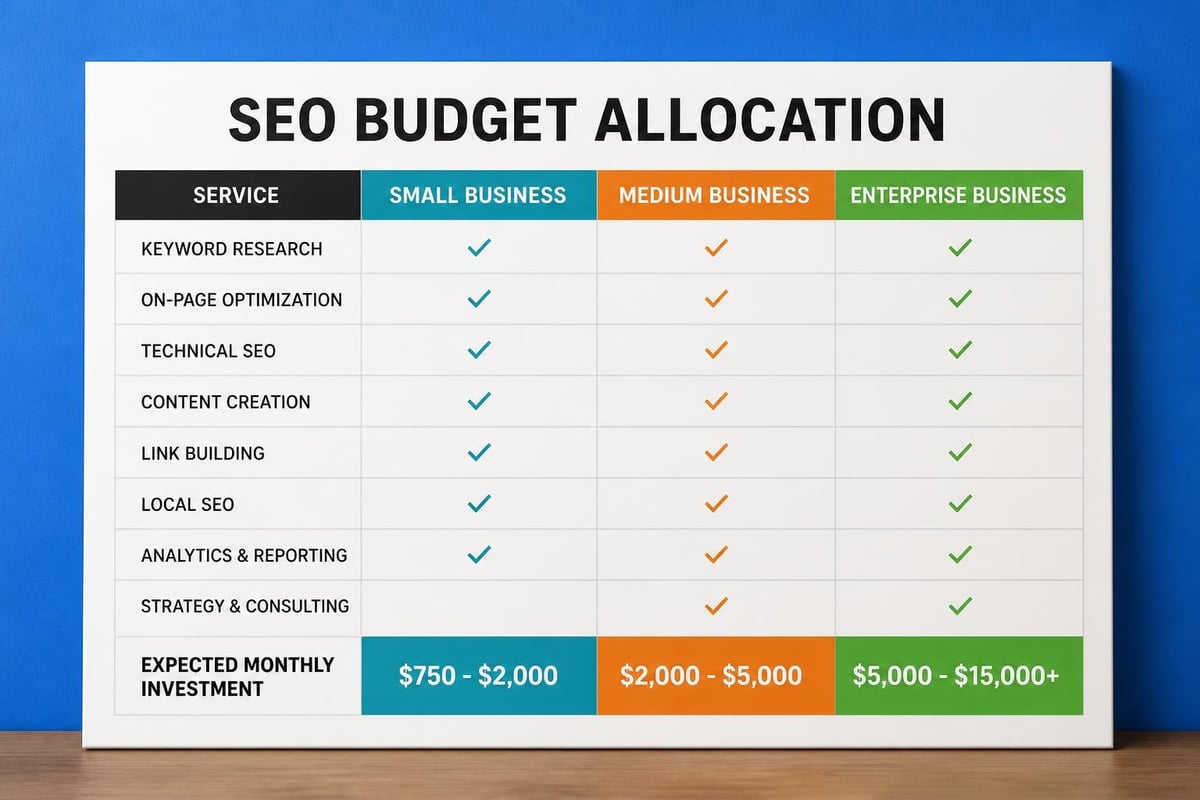
Breaking Down Service Costs by Business Size
Different business sizes require different SEO approaches, directly affecting the cost of search engine optimization they should expect to invest.
Small Business SEO Costs
Small businesses and startups typically invest $500 to $2,000 monthly. This budget covers:
- Local SEO optimization
- Google Business Profile management
- Basic on-page optimization
- Monthly content creation (2-4 articles)
- Citation building
- Basic link acquisition
- Monthly performance reports
Small businesses benefit most from focused strategies targeting local markets where competition remains manageable and results appear faster.
Mid-Sized Business SEO Investment
Growing companies with broader reach spend $2,000 to $5,000 monthly. This range supports:
- Competitive keyword targeting across multiple service areas
- Regular content production (4-8 quality articles monthly)
- Strategic link building from relevant industry sources
- Technical SEO improvements addressing speed, mobile optimization, structured data
- Conversion rate optimization to maximize traffic value
- Detailed analytics and reporting tracking ROI
Research on SEO pricing tiers shows mid-sized businesses see significant returns when maintaining consistent investment over 6-12 months.
Enterprise SEO Budgets
Large organizations typically allocate $5,000 to $20,000+ monthly for comprehensive campaigns including:
- Advanced technical audits and ongoing optimization
- Large-scale content operations producing 15-30+ articles monthly
- Sophisticated link acquisition through digital PR and outreach
- Multi-location SEO for businesses with numerous physical locations
- International SEO with multilingual content and geo-targeting
- Custom development for SEO-friendly features and functionality
- Dedicated account management with strategic planning
Enterprise campaigns demand extensive resources because they target high-volume, highly competitive keywords while managing complex site architectures.
What Services Should Be Included
Understanding exactly what you receive for your investment prevents surprises and ensures comprehensive optimization. Quality SEO should address multiple interconnected elements.
Technical SEO foundation includes site speed optimization, mobile responsiveness, secure HTTPS implementation, XML sitemap creation, robots.txt configuration, and structured data markup. These elements ensure search engines can properly crawl and understand your site.
On-page optimization covers keyword research, title tag optimization, meta description writing, header tag structure, internal linking strategy, and image optimization for better performance.
Content development should deliver original, valuable articles addressing user intent. Quality matters more than quantity. One well-researched 2,000-word guide outperforms five thin 400-word posts.
Link building remains essential despite algorithm changes. Legitimate strategies include:
- Guest posting on relevant industry sites
- Digital PR generating media mentions
- Resource page outreach
- Broken link building
- Strategic partnerships
Regular reporting and communication keeps you informed about progress, challenges, and opportunities. Monthly reports should track rankings, organic traffic, conversions, and specific action items.
According to comprehensive SEO cost analysis, these services form the minimum viable approach for sustainable results.
Red Flags: When SEO Costs Too Little
Extremely low-cost SEO often creates more problems than it solves. Certain price points simply can't support quality work.
Below $300 monthly rarely delivers legitimate value. At this price point, providers either use automated tools that violate guidelines, outsource to inexperienced workers, or spread resources so thin across clients that your site receives minimal attention.
Guaranteed rankings for competitive terms should raise immediate concerns. No ethical SEO can guarantee specific positions since search engines control ranking algorithms.
Packages promising "unlimited keywords" typically target long-tail phrases with zero search volume or commercial value. Ranking for irrelevant keywords doesn't drive business results.
One-time optimization fees suggesting permanent results ignore SEO's ongoing nature. Competitors continuously improve, algorithms regularly update, and markets constantly evolve.
Black-hat techniques like private blog networks, keyword stuffing, or link schemes might cost less initially but risk severe penalties that devastate your organic visibility.
Signs of quality SEO include transparent communication about processes, realistic timelines, case studies demonstrating results, and clear explanations of strategies employed.
How to Budget for SEO Success
Smart budgeting aligns your investment with realistic expectations and business objectives. Start by defining clear goals beyond just "better rankings."
Calculate customer lifetime value to determine how much you can afford to acquire new customers. If your average customer generates $5,000 in profit, investing $500 to acquire them through SEO makes financial sense.
Compare SEO to other marketing channels. Research shows organic search typically delivers higher ROI than paid advertising long-term, though results take longer to materialize. Understanding SEO versus paid ads helps you allocate resources effectively.
Plan for 6-12 month commitments minimum. SEO compounds over time. Monthly investments in content and links accumulate, creating momentum that accelerates results.
| Timeline | Expected Progress | Investment Focus |
|---|---|---|
| Months 1-3 | Foundation building, initial improvements | Technical fixes, content audit, strategy |
| Months 4-6 | Moderate traffic increases, some ranking gains | Content production, link building, optimization |
| Months 7-12 | Significant visibility improvements, conversions | Scaling what works, competitive expansion |
Allocate 10-20% of revenue for digital marketing when possible. Within that budget, SEO typically warrants the largest share due to its compounding returns.
Reserve budget flexibility for opportunities like viral content promotion or responding to algorithm updates.

Regional Cost Differences in SEO Services
Location significantly impacts the cost of search engine optimization due to varying labor costs and market conditions. Understanding these differences helps you evaluate proposals fairly.
United States providers typically charge $100-$250 hourly or $2,000-$10,000 monthly for quality services. Major markets like New York, San Francisco, and Los Angeles command premium rates.
Canadian SEO specialists charge similar rates to US providers, ranging from $1,500-$8,000 monthly depending on city and expertise level.
United Kingdom rates generally fall between £1,000-£5,000 monthly, with London-based agencies at the higher end.
Philippine-based specialists offer competitive pricing without sacrificing quality. Many Filipino SEO professionals trained with Western agencies but operate with lower overhead, passing savings to clients. Monthly retainers typically range from $500-$3,000 for comprehensive services.
Eastern European providers price similarly to Philippine specialists, offering strong technical skills at $800-$4,000 monthly.
Indian SEO companies often advertise the lowest rates ($300-$2,000 monthly) but service quality varies dramatically. Thorough vetting becomes essential.
Data on SEO pricing across different markets reveals that location affects cost more than it affects quality. Experienced specialists deliver results regardless of geography when they follow proven methodologies.
In-House SEO Versus Outsourcing Costs
Building internal SEO capabilities requires different investments than hiring external specialists. Each approach offers distinct advantages depending on your situation.
In-House SEO Expenses
Hiring a full-time SEO specialist involves:
- Salary: $45,000-$85,000 annually for mid-level specialists, $85,000-$150,000 for senior professionals
- Benefits: Health insurance, retirement contributions, paid time off (typically 25-40% of salary)
- Tools and software: $200-$800 monthly for essential platforms
- Training and development: $1,000-$5,000 annually keeping skills current
- Management overhead: Time supervising and directing strategy
Total annual cost: $60,000-$200,000 depending on experience level and location.
In-house teams make sense when you have large websites requiring daily attention, need absolute control over strategy, or have sufficient budget to hire multiple specialists covering different SEO disciplines.
Outsourcing Advantages
Working with external specialists or agencies costs:
- Monthly retainers: $1,000-$10,000 based on scope
- Annual investment: $12,000-$120,000
Benefits include immediate access to diverse expertise, no benefits or overhead costs, scalable services adjusting to needs, and fresh perspectives from specialists working across industries.
Many businesses find the optimal approach combines both: an in-house coordinator managing strategy while outsourcing specialized tasks like technical audits, link building, or content creation to experts.
Evaluating ROI and Setting Expectations
Understanding returns on your SEO investment requires tracking the right metrics and setting realistic expectations. The cost of search engine optimization should be evaluated against tangible business outcomes, not vanity metrics.
Track conversions, not just traffic. Rankings and visitor counts matter only if they generate leads, sales, or other valuable actions. Configure goal tracking in Google Analytics to measure form submissions, phone calls, purchases, or newsletter signups.
Calculate cost per acquisition by dividing total SEO investment by new customers gained through organic search. Compare this to other channels like paid ads, social media, or traditional marketing.
Monitor assisted conversions since users often discover your business through organic search but convert later through direct visits or other channels. Multi-touch attribution reveals SEO's full impact.
Set staged expectations:
- Months 1-3: Foundation building with minimal traffic increases
- Months 4-6: 20-40% traffic growth for less competitive keywords
- Months 7-12: 50-100%+ traffic increases as momentum builds
- Year 2+: Compounding returns with established authority
Industry and competition affect timelines dramatically. Local services in small markets might see results within 90 days, while competitive B2B software could require 12-18 months.
Academic research on search costs and benefits demonstrates that organic search delivers sustained value beyond immediate conversions, including brand awareness and market research insights.
Common SEO Pricing Questions Answered
Business owners frequently ask specific questions about SEO costs before committing to services. Clear answers help you make confident decisions.
How much should a small business spend on SEO?
Most small businesses achieve results investing $1,000-$2,500 monthly. This supports essential services without overextending budgets. Less than $500 rarely provides sufficient resources for meaningful progress.
What's included in a typical monthly retainer?
Standard packages include keyword research, on-page optimization, content creation (2-4 articles), technical monitoring, link building outreach, and monthly reporting. Specific deliverables vary by provider and price point.
Can I do SEO myself to save money?
Yes, but expect significant time investment and a steep learning curve. DIY SEO works for motivated business owners with technical aptitude, but hiring an experienced SEO specialist accelerates results and avoids costly mistakes.
How long until I see results?
Initial improvements often appear within 3-4 months for less competitive keywords. Significant traffic and conversion increases typically require 6-12 months of consistent effort.
Should I pay for SEO or Google Ads?
Both serve different purposes. Ads deliver immediate visibility while SEO builds sustainable long-term traffic. Combining both maximizes results, but if choosing one, consider your timeline and budget. Comparing SEO and PPC strategies helps determine the right mix.
What happens if I stop paying for SEO?
Your rankings gradually decline as competitors continue optimizing and search engines refresh results. However, previous work retains value longer than paid advertising, which stops immediately when spending ends.
Are cheaper overseas SEO providers worth it?
Quality varies dramatically regardless of location. Many offshore specialists deliver excellent results at competitive prices, but thoroughly vet providers through references, case studies, and trial periods before committing.
Avoiding Common SEO Investment Mistakes
Smart businesses avoid predictable pitfalls that waste budgets and delay results. Learning from common mistakes protects your investment.
Choosing based solely on price often backfires. The cheapest option rarely delivers value while the most expensive doesn't guarantee superior results. Evaluate providers on experience, methodology, communication, and proven outcomes.
Expecting instant results sets you up for disappointment. SEO requires patience. Providers promising first-page rankings within 30 days either target non-competitive keywords or use risky tactics.
Neglecting content quality undermines technical optimization. Understanding how to find blog topics that rank ensures your content investment drives actual traffic.
Ignoring technical foundations like site speed, mobile optimization, and proper indexing prevents even great content from ranking. Address technical issues before investing heavily in content or links.
Failing to align SEO with business goals wastes resources. Rankings mean nothing without conversions. Ensure your SEO strategy targets keywords that attract ready-to-buy customers, not just casual browsers.
Switching providers too frequently prevents strategies from maturing. Give quality providers at least 6 months before evaluating performance. Constant changes reset progress and waste previous investments.
Micromanaging specialists while simultaneously lacking SEO knowledge creates friction. Trust professionals you've vetted, but request clear explanations of strategies and regular progress updates.
When to Increase Your SEO Investment
Recognizing the right time to scale spending accelerates growth without wasteful expenditure. Several indicators suggest you're ready for increased investment.
Consistent positive ROI from current efforts justifies expansion. If you're profitably acquiring customers through organic search, reinvesting those profits into more aggressive SEO compounds returns.
Maxed capacity on current plan signals readiness to scale. When your content calendar is full, you're publishing consistently, and link building opportunities exceed capacity, adding resources makes sense.
Competitive pressure increasing requires defensive investment. If competitors invest heavily in SEO while you maintain static spending, they'll eventually overtake your positions.
Business expansion into new products, services, or locations needs corresponding SEO support. Each new offering requires keyword research, content creation, and optimization work.
Algorithm updates affecting rankings sometimes require additional technical work or content improvements to recover visibility.
Available capital for growth initiatives presents opportunities to accelerate progress. If you have marketing budget flexibility and SEO has proven effective, shifting funds from less productive channels maximizes overall ROI.
Plateauing results despite consistent effort might indicate you've maximized current strategies. Expanding into more competitive keywords, comprehensive content campaigns, or sophisticated link building requires increased investment.
The cost of search engine optimization varies widely based on your business size, competitive landscape, and growth objectives, but understanding pricing models and expected returns helps you budget wisely for sustainable results. With nearly 15 years of experience helping businesses improve their online visibility, Cyrel P. Nicolas offers transparent, results-focused SEO services tailored to your specific goals and budget, ensuring every peso you invest works toward measurable growth in rankings, traffic, and conversions.