
Understanding where your website stands in search engine results is essential for measuring SEO success and identifying growth opportunities. When you find SEO ranking of website data, you gain actionable insights that inform your content strategy, reveal competitor gaps, and help prioritize optimization efforts. This guide walks through practical methods and reliable tools that make rank tracking accessible for businesses of all sizes.
Why You Need to Monitor Your Website Rankings
Tracking your search engine positions helps you measure whether your SEO investments deliver results. Without regular monitoring, you're essentially operating blind, unable to determine which strategies work and which need adjustment.
When you consistently find SEO ranking of website metrics, you can:
- Identify trending keywords that bring new traffic opportunities
- Detect ranking drops before they significantly impact revenue
- Validate content updates by measuring position improvements
- Benchmark against competitors in your industry
- Justify SEO budgets with concrete performance data
Rankings fluctuate daily based on algorithm updates, competitor activity, and seasonal trends. Monitoring these changes helps you respond quickly rather than discovering problems weeks later when recovery becomes harder.
The Business Impact of Rank Tracking
Higher search positions correlate directly with increased click-through rates and organic traffic. Studies show that the first three organic results capture over 50% of all clicks, making position monitoring critical for visibility.
Understanding your rankings also reveals content gaps where competitors outrank you, providing clear direction for new content creation or page optimization.
Manual Methods to Check Your Rankings
The simplest way to find SEO ranking of website positions is through direct search engine queries, though this approach has limitations you should understand.
Using Incognito Mode for Accurate Results
Open your browser's private or incognito window and search for your target keyword. This prevents personalized results based on your search history and location from skewing the data.
Steps for manual checking:
- Open an incognito or private browsing window
- Navigate to Google or your preferred search engine
- Enter your exact target keyword
- Scroll through results to locate your website
- Note the position number (page 1 = positions 1-10, page 2 = 11-20, etc.)
- Repeat for different keywords and locations
This method works for occasional spot checks but becomes impractical when tracking dozens or hundreds of keywords across multiple locations.

Location-Specific Searches
Google customizes results based on user location, making geographic specificity important for local businesses. Add location parameters to your searches or use VPN services to simulate searches from different cities or countries.
For example, searching "coffee shop" in Manila returns different results than the same query in Cebu. If your business serves specific regions, test rankings in those areas.
Professional Rank Tracking Tools
Professional SEO tools automate rank tracking and provide historical data, competitor comparisons, and bulk keyword monitoring that manual methods cannot match.
Google Search Console
Google Search Console is free and shows which keywords already drive impressions and clicks to your site, along with average positions.
| Feature | Capability | Best For |
|---|---|---|
| Performance Report | Shows average position, clicks, impressions | Identifying current ranking keywords |
| Query Analysis | Lists all search terms triggering your pages | Finding unexpected keyword opportunities |
| Page-Level Data | Breaks down performance by URL | Diagnosing page-specific issues |
| Date Comparisons | Compares periods to track changes | Measuring optimization impact |
While Search Console doesn't track specific keyword targets you choose, it reveals the actual search terms users employ to find your site, often uncovering valuable keywords you hadn't considered.
Dedicated Rank Tracking Platforms
Tools like Ahrefs’ Keyword Rank Checker and Semrush’s SERP Checker offer comprehensive rank monitoring with features manual checking cannot provide.
Key features of professional tools:
- Daily automated tracking across hundreds of keywords
- Historical trend graphs showing position changes over time
- Local rank tracking for specific cities or regions
- Competitor monitoring to benchmark your performance
- Mobile vs. desktop separate tracking
- SERP feature tracking (featured snippets, knowledge panels, local packs)
These platforms require subscriptions but save countless hours while providing deeper insights. Ahrefs’ SERP Checker also analyzes ranking difficulty and shows why current top-ranking pages hold their positions.
All-in-One SEO Suites
Comprehensive platforms combine rank tracking with keyword research, backlink analysis, site audits, and competitive intelligence. When you find SEO ranking of website data through these tools, you also access related metrics that explain ranking performance.
Popular options include:
- Semrush – Extensive keyword database with position tracking across 140+ countries
- Ahrefs – Strong backlink data combined with rank monitoring
- SE Ranking – Budget-friendly option with robust tracking features
- Moz Pro – User-friendly interface with good local tracking
TechRadar’s review of SE Ranking highlights how this platform has evolved into a comprehensive solution, making it easier to monitor rankings alongside other critical metrics.
Understanding Ranking Metrics Beyond Position
Position numbers tell only part of the story. To truly find SEO ranking of website performance, you need context around those numbers.
Search Volume and Opportunity
A #1 ranking for a keyword with zero monthly searches generates no traffic. Combine position tracking with search volume data to prioritize keywords that actually drive visitors.
Calculate potential traffic by multiplying search volume by expected click-through rates for your position:
| Position | Average CTR | Monthly Searches | Estimated Visits |
|---|---|---|---|
| 1 | 28.5% | 1,000 | 285 |
| 3 | 11.0% | 1,000 | 110 |
| 5 | 7.2% | 1,000 | 72 |
| 10 | 2.5% | 1,000 | 25 |
This calculation helps you understand whether improving from position 5 to position 3 justifies the optimization effort based on potential traffic gains.
Ranking Volatility and Stability
Some keywords show stable rankings while others fluctuate wildly. Understanding this volatility helps you interpret ranking changes correctly.
A keyword that moves between positions 4-7 daily reflects competitive SERP dynamics rather than specific problems with your page. Keywords with stable positions indicate established authority in that topic area.

SERP Features Impact
Modern search results include featured snippets, local packs, knowledge panels, and other features that change click distribution. A traditional #1 organic position may actually receive fewer clicks if a featured snippet appears above it.
When you find SEO ranking of website positions, note which SERP features appear for those queries. Tools like Backlinko’s Free SEO Checker help identify on-page optimization opportunities that could capture these features.
Tracking Rankings Across Different Devices
Mobile and desktop search results differ significantly, making device-specific tracking important for comprehensive monitoring.
Mobile-First Indexing Implications
Google primarily uses mobile versions of pages for indexing and ranking. If your mobile experience differs from desktop, rankings may vary between devices.
Mobile ranking factors to monitor:
- Page speed on mobile networks
- Mobile-friendly design and tap targets
- Viewport configuration
- Readable font sizes without zooming
- Adequate spacing between interactive elements
Track rankings separately for mobile and desktop to identify device-specific optimization needs. Some rank tracking tools automatically separate these metrics.
Voice Search Considerations
Voice queries typically use longer, more conversational phrases than typed searches. "Best Italian restaurant near me" represents a voice-style query, while "Italian restaurant" reflects typical typing behavior.
Voice search results often pull from featured snippets and local packs. Tracking your presence in these SERP features becomes critical as voice search adoption grows, particularly for local businesses serving specific geographic areas.
Competitor Rank Analysis
Understanding competitor rankings provides context for your own positions and reveals opportunities they've captured that you haven't.
Identifying Your True Competitors
Your business competitors and search competitors aren't always identical. A small local business might compete in search results against national brands with massive budgets but different business models.
Find your search competitors by:
- Identifying keywords important to your business
- Analyzing who consistently ranks in top 10 positions
- Evaluating which competitors appear across multiple keywords
- Noting domain authority and content depth of top-ranking sites
This analysis reveals whether you're competing against established authorities or newer sites, informing your content and link-building strategies.
Gap Analysis for Quick Wins
Compare your rankings against competitors to find keywords where they rank but you don't, or where you rank lower on page one. These represent immediate opportunities.
Keywords to prioritize:
- Where competitors rank positions 1-5 and you rank 6-20
- Where you already have content but underperform
- Where search volume justifies optimization effort
- Where your content quality could reasonably surpass competitors
Research from academic studies on SEO and content quality confirms that strategic content improvements based on competitor analysis significantly impact rankings, particularly when combined with technical optimization.
Local SEO Ranking Considerations
For businesses serving specific geographic areas, local ranking factors require separate attention from general organic rankings.
Google Business Profile Impact
Google Business Profile listings appear in local packs and Maps results, often above traditional organic listings. Your position in these features dramatically affects visibility for local searches.
Local pack ranking factors:
- Proximity to searcher's location
- Google Business Profile completeness and optimization
- Review quantity, quality, and recency
- Citation consistency across directories
- Localized on-page content
Track both your local pack position and traditional organic rankings for location-based keywords. These often move independently based on different ranking factors.
Multi-Location Tracking
Businesses serving multiple cities need location-specific rank tracking. A plumber ranking well in one city may not appear in results for nearby areas.
Set up separate tracking for each service area, using that location as the tracking point. This reveals where your visibility needs improvement and which markets already convert well.
Setting Up a Ranking Tracking System
Effective rank monitoring requires organized systems rather than sporadic checks. Here's how to build a sustainable tracking process.
Keyword Selection Strategy
You can't track every possible keyword, so prioritize based on business value and tracking capacity.
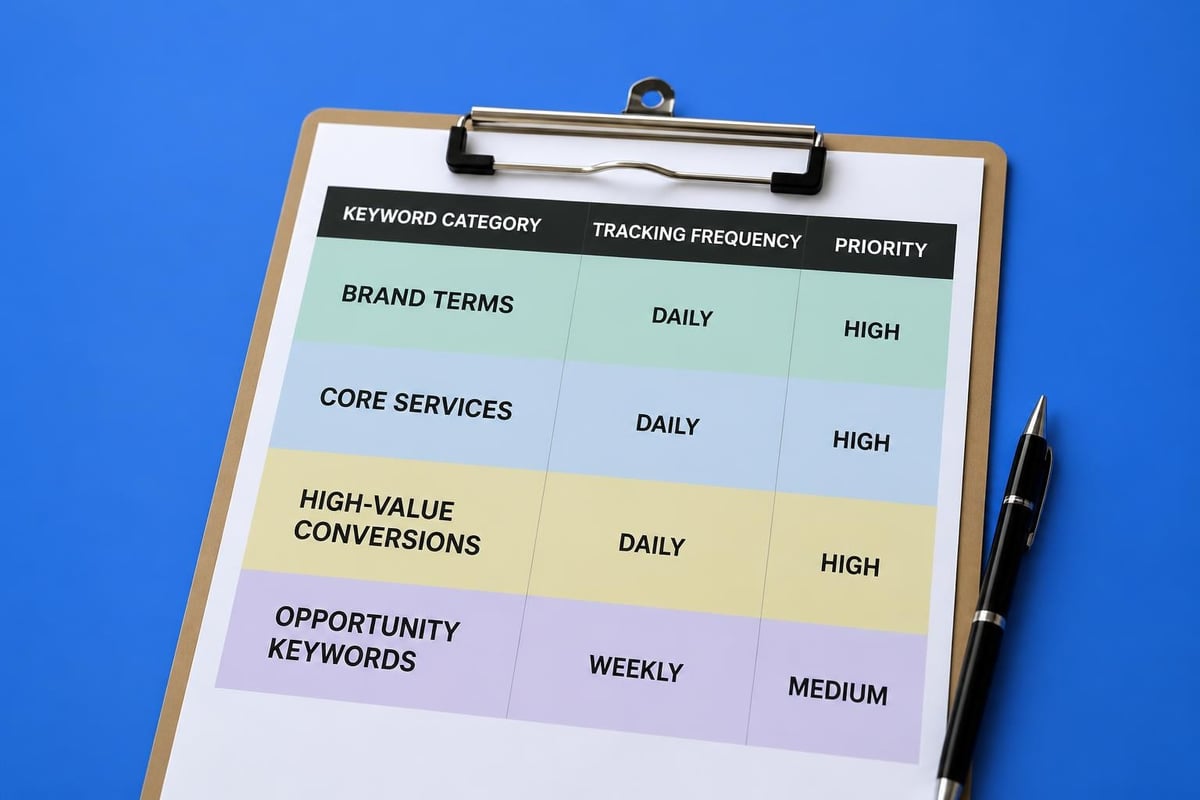
Start with these keyword categories:
- Brand terms – Your business name and variations
- Core service terms – Primary offerings in your location
- High-value conversions – Keywords that historically convert well
- Opportunity keywords – Terms where you rank positions 11-30 with improvement potential
- Competitor keywords – Terms where competitors significantly outrank you
Begin with 20-50 keywords and expand as you establish tracking routines. Trying to monitor too many initially leads to analysis paralysis.
Tracking Frequency Guidelines
Different keyword types need different tracking frequencies:
| Keyword Type | Suggested Frequency | Reason |
|---|---|---|
| Core business terms | Daily | Critical for revenue, need quick problem detection |
| Brand keywords | Weekly | Typically stable, monitor for reputation issues |
| New content targets | Daily for first month, then weekly | Track initial ranking establishment |
| Long-tail keywords | Weekly or monthly | Less volatile, resource-efficient |
| Seasonal terms | Daily during season, monthly off-season | Maximize seasonal opportunities |
Most professional tools default to daily tracking, but you don't need to review data daily unless you're actively optimizing specific keywords.
Documentation and Reporting
Create a simple spreadsheet or use your tracking tool's reporting features to document:
- Baseline rankings when you start tracking
- Major algorithm updates that might explain fluctuations
- Content updates and their publication dates
- Link building activities and when they occurred
- Ranking changes and potential causes
This documentation helps you connect optimization actions to ranking results, building knowledge about what works for your specific site and industry. If you're working with professional SEO services, this documentation also facilitates better communication about strategy effectiveness.
Technical Considerations for Accurate Tracking
Several technical factors affect ranking accuracy when you find SEO ranking of website positions through various tools.
Personalization and Location
Google personalizes results based on search history, location, device, and dozens of other signals. This means different users searching the same keyword see different results.
Professional tracking tools solve this by:
- Using datacenter IP addresses without search history
- Specifying exact geographic coordinates
- Separating mobile and desktop tracking
- Providing "true" rankings without personalization
When manually checking, always use incognito mode and consider your actual location's impact on results.
Caching and Update Delays
Rank tracking tools check positions at specific intervals, meaning data represents a snapshot rather than real-time rankings. Tools typically update daily, though some offer more frequent checks.
Google's own data in Search Console updates with a 2-3 day delay. Don't panic over single-day ranking drops; look for multi-day trends instead.
International and Multi-Language Sites
If your site targets multiple countries or languages, track rankings in each target market using the appropriate search engine and language settings.
A site ranking well on Google.com (US) may perform differently on Google.co.uk or Google.com.ph. Use tools that support international tracking or set up separate tracking profiles for each market.
Interpreting Ranking Changes
When you find SEO ranking of website fluctuations, proper interpretation prevents overreaction to normal variations while catching genuine problems.
Algorithm Updates vs. Competitive Changes
Google releases thousands of algorithm updates annually, with major updates several times per year. Cross-reference ranking drops with update announcements from Google or tracking sites that monitor algorithm volatility.
If only your rankings drop, you likely have site-specific issues. If rankings across many unrelated sites fluctuate simultaneously, an algorithm update probably caused it.
Seasonal and Trend-Based Fluctuations
Some keywords naturally fluctuate based on seasonal interest or trending topics. "Christmas decorations" ranks higher in November-December than July.
Compare year-over-year data for the same time period rather than month-to-month comparisons for seasonal terms. This reveals whether you're growing, declining, or maintaining position relative to normal seasonal patterns.
New Competitor Content
When competitors publish comprehensive new content targeting your keywords, you might see ranking declines even without changes to your own pages.
Monitor competitor content publication using tools or manual checks. If a competitor launches a detailed guide on a topic where you have a brief article, that explains ranking changes and suggests your response.
Actionable Steps After Finding Your Rankings
Discovering your rankings is just the starting point. The real value comes from acting on that data.
Prioritizing Optimization Efforts
Focus optimization work on keywords where:
- You rank positions 4-15 (page 1 bottom or page 2 top)
- Search volume justifies the effort
- Your content depth or quality could reasonably improve
- You already have some topical authority
These "low-hanging fruit" keywords typically require less effort than breaking into top results from position 50 or trying to overtake massive authority sites from position 2.
Content Improvement Based on Rankings
For keywords where you rank but underperform expectations:
- Analyze top-ranking content to identify depth, format, or angle differences
- Update content comprehensiveness by adding sections covering subtopics
- Improve content structure with better headings, lists, and scannability
- Add relevant internal links to and from related content
- Update outdated information that might lower trust signals
If you're running a WordPress site, WordPress SEO services can help optimize both content and technical elements that influence rankings.
Link Building Strategy Adjustments
For keywords where you rank poorly despite strong content, backlink gaps might explain the difference. Compare your backlink profile to top-ranking competitors using tools like Ahrefs or Semrush.
Focus link building on:
- Pages ranking positions 11-30 with good content
- Topics where you lack authoritative backlinks
- Keywords with clear commercial intent
- Content that could reasonably earn editorial links
Understanding the role of backlinks in building a high-quality link profile helps you develop sustainable link acquisition strategies rather than relying on quick-fix tactics.
Common Ranking Tracking Mistakes
Avoid these pitfalls that lead to incorrect conclusions or wasted effort.
Tracking Too Many Keywords Too Soon
New sites or businesses just starting SEO often try tracking hundreds of keywords immediately. This creates overwhelming data without actionable focus.
Start narrow and expand as you build processes and capacity. Twenty well-chosen, actively optimized keywords deliver better results than 200 monitored passively.
Ignoring Search Intent Alignment
A keyword might drive traffic without converting because searcher intent doesn't match your content. Position #1 for an informational query won't generate sales if you've optimized a product page.
Review actual user behavior from analytics alongside rankings. High rankings with poor engagement suggest intent misalignment, indicating you should either adjust the content or target different keywords.
Overreacting to Daily Fluctuations
Rankings fluctuate daily based on personalization tests, minor algorithm adjustments, and competitive changes. A drop from position 4 to position 7 for one day rarely signals serious problems.
Watch for sustained trends over 7-14 days rather than reacting to single-day changes. This prevents wasting time "fixing" problems that self-correct naturally.
Finding and tracking your SEO rankings gives you the visibility needed to make informed optimization decisions and measure progress toward your traffic and revenue goals. By combining manual spot-checks with professional tracking tools, understanding the context around position numbers, and taking systematic action based on data, you turn raw ranking information into business growth.
If you need expert help to find SEO ranking of website metrics that matter and build strategies that move those numbers in the right direction, Cyrel P. Nicolas and his team bring nearly 15 years of SEO experience to help businesses improve their search visibility, drive qualified organic traffic, and convert that visibility into measurable sales growth.